If you have been asked for a form about your "service in the armed forces", the document the Department means is Form 1399 — and its official title is Declaration of Service. It is broader than the army: it reaches police, paramilitary, security and intelligence service too.
I treat Form 1399 as the third member of the character trio, alongside Form 80 and Form 1221. Get one of the three wrong and the others expose it. Here is what Form 1399 asks, and where applicants come unstuck.
Asked to complete Form 1399? Book a consultation before lodging.
What Form 1399 is
Form 1399, Declaration of Service (design date 09/20), records your history of service in a military, paramilitary, security, police or intelligence force — together with your employment history and the details of any discharge.
The Department collects it under its authority in the Migration Act 1958 (Cth) and the Australian Citizenship Act 2007 (Cth). It feeds two assessments at once: the character test under the Migration Act 1958 (Cth) s 501, and, where relevant, security assessment by ASIO. Download the current form only from the official source: Form 1399 on the Department of Home Affairs website.
You will typically be asked for it where your history — or your country of service — raises a service question the Department needs answered before it can be satisfied of your character.
The service history questions
Part B is the heart of the form, and it is wider than most applicants expect.
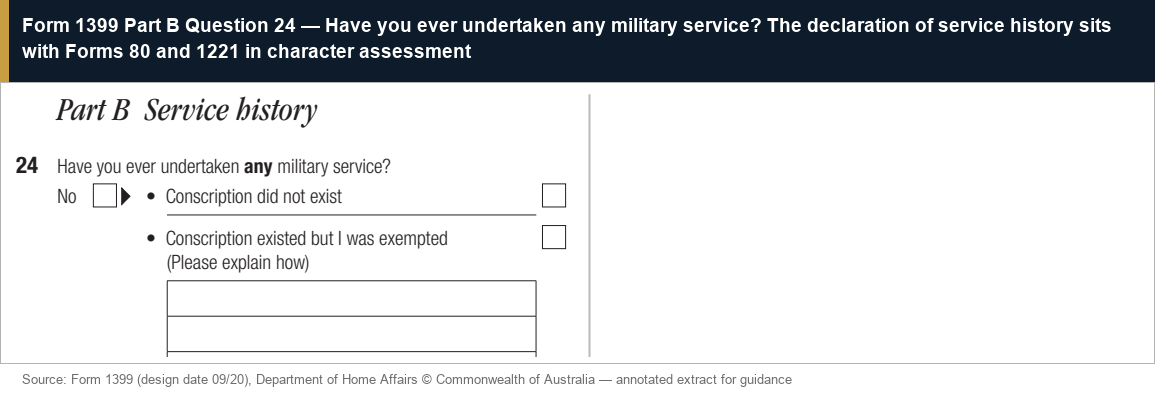
Question 24 asks whether you have ever undertaken any military service — with structured answers that account for conscription that did not exist, conscription you were exempted from, and service actually performed. Question 25 broadens it to any other military, paramilitary, security, police or intelligence service. Question 26 asks whether you were ever a guard or official at a detention centre or prison.
Two traps recur. First, applicants forget short or compulsory service — a year of national service two decades ago is still service, and still declarable. Second, they read "military" narrowly and overlook police, security or intelligence roles that Questions 25 and 26 plainly capture. If you answered yes to any of Questions 24, 25 or 26, you give the full detail of your service history and attach documentation to support it.
The declaration is a warning, not a formality
Part D closes the form with a declaration, and it does not mince words.
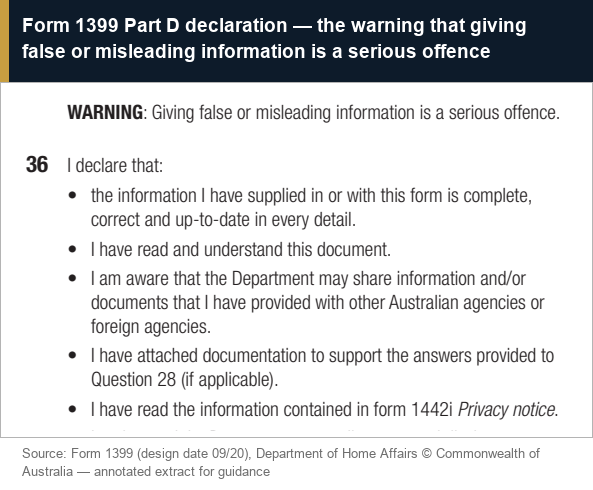
Giving false or misleading information is a serious offence. Under the Migration Act 1958 (Cth) s 234 it is an offence in its own right; and false or misleading information engages Public Interest Criterion 4020, which can carry an exclusion period of three years — ten where identity is involved. A concealed period of service discovered later does far more damage than a frankly declared one ever would.
Common mistakes and their consequences
Inconsistency with Form 80 and Form 1221. The three forms ask overlapping questions. A period of service on one and not the others is exactly the kind of discrepancy that triggers a natural justice letter. Reconcile all three before lodging.
Omitting conscription or brief service. "It was only national service" is not a reason to leave it out. Declare it and explain it.
Reading "service" too narrowly. Police, paramilitary, security and intelligence roles all count. So does being a guard at a detention centre or prison.
Not attaching documentation. Where you declare service, support it — discharge papers, service records, translations where needed. An unsupported "yes" invites follow-up and delay.
How Form 1399 fits your application
Form 1399 rarely arrives alone. It sits with Form 80 and Form 1221 as the documents the Department uses to build a character and security picture, and consistency across all three is what protects you. If an earlier answer was wrong when you gave it, correct it on a Form 1023; if your circumstances have since changed, a Form 1022.
If a lawyer acts for you, your Form 956 directs the Department's correspondence — including any request for a 1399 — to them. And if a character concern has already produced a refusal, that is where a visa appeal begins.
If you have served in any force and have been asked for a Form 1399, book a $97 10-minute chat with me. Service history is one of the areas where careful, consistent disclosure matters most — and where I can help you get all three character forms telling one clean story.
Frequently asked questions
What is Form 1399 used for?
Form 1399, the Declaration of Service, records your service history in military, paramilitary, security, police or intelligence forces, along with your employment history and any discharge details. The Department uses it for character and, where relevant, security assessment.
Do I have to declare national service or conscription on Form 1399?
Yes. Any military service is declarable, including compulsory or national service, however brief and however long ago. Question 24 is structured to capture conscription and exemptions as well as service performed.
Does Form 1399 only cover the army?
No. It covers military, paramilitary, security, police and intelligence service, and asks separately whether you were a guard or official at a detention centre or prison.
What happens if I leave service off Form 1399?
A concealed period of service that later surfaces can be treated as false or misleading information, engaging Public Interest Criterion 4020 and its exclusion periods, and it undermines the consistency of your Form 80 and Form 1221. Declare and document your service.
Does Form 1399 need to match my other character forms?
Yes. It overlaps with Form 80 and Form 1221, and the three must agree exactly. Reconcile them before lodging.
Have a service history and been asked for a Form 1399? I act for visa and citizenship applicants nationwide from eight locations, and I make sure the character forms tell one consistent story. Book your $97 10-minute chat — or if you are ready to engage, start at myvisa.com.au/work.