Form 1221 arrives in your inbox looking like Form 80's little sibling — same family of questions, half the length. That resemblance is exactly why it is dangerous: people dash it off from memory, and hand the Department a second version of their life story that doesn't quite match the first.
Ten pages, most of them easy. Here is what the form is actually for, how it differs from Form 80, and the three questions where I see it go wrong.
What Form 1221 is
Form 1221, officially titled Additional personal particulars information, is a Department of Home Affairs questionnaire used across many visa types — partner, skilled, business, student and visitor cases among them — when a case officer wants more background than the application form collects. It covers your identity and identity documents, addresses, international movements, employment, education, and your intended activities in Australia.
There is no rule prescribing when it is requested. It arrives under a s 56 Migration Act 1958 (Cth) request, or appears in a document checklist, and once requested it is not optional. Some applicants lodge it proactively where their visa type routinely attracts it.
Download the current form only from the official source: Form 1221 on the Department of Home Affairs website.
Form 1221 versus Form 80 — and whether you need both
The honest answer to "do I need both Form 80 and Form 1221?" is: you need whichever the Department asks for — and if it asks for both, you complete both.
The two overlap heavily, but they are not the same instrument. Form 80 is the deep character and security questionnaire — 19 pages, complete employment history, ten years of addresses and travel, military and government service, built for character assessment under s 501. Form 1221 is broader-purpose and shorter, with more attention to your intended activities in Australia — what you will do, where, and for whom — which is why it turns up in visitor, student and business contexts where Form 80 often doesn't.
When both are requested, the only rule that matters is consistency. Same dates, same employers, same trips, same names, across both forms and the application itself. Every discrepancy between your Form 80 and your Form 1221 is a discrepancy you created under your own signature — and inconsistency is the raw material of PIC 4020 findings.
My practice method is unglamorous and effective: build one master chronology of addresses, employment and travel first, then populate every form from that single source. Never complete two forms from memory on different days.
The three questions that need real care
Question 14: every identity document you have ever held
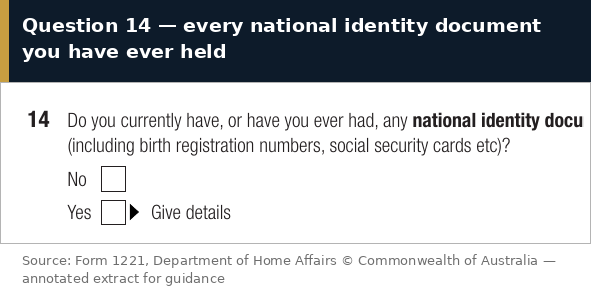
Note the tense: have you ever had. Expired passports, old national ID cards, superseded numbers from a previous country of residence — all of it. Identity is the one area where the Department's appetite is absolute, and an old document surfacing later that you never declared reads as concealment, not housekeeping.
Question 25: your entire employment history
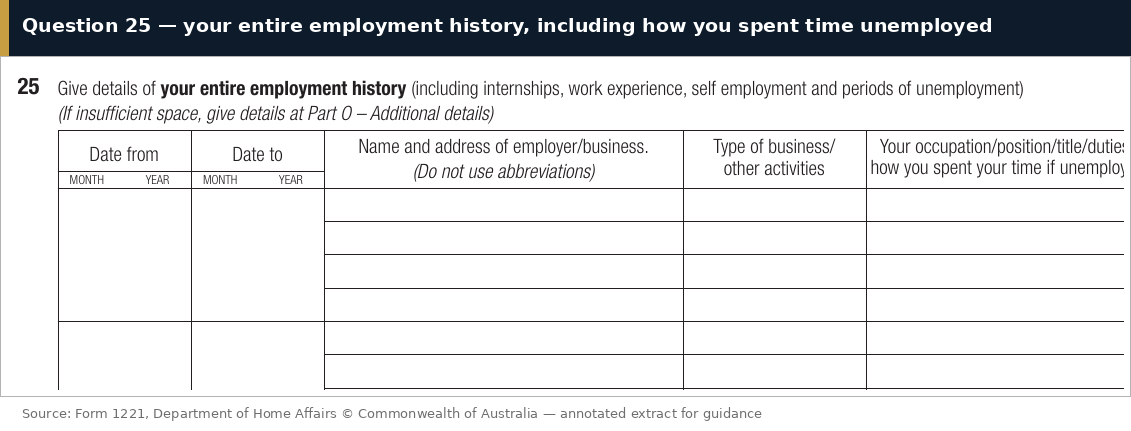
The form says entire — not the last ten years — and it expressly includes internships, work experience and self-employment. Look at the final column heading in the form's own table: how you spent your time if unemployed. Gaps are not blank space; they are answers you haven't given yet. Account for study, home duties, job-seeking, caring responsibilities — month by month, no abbreviations, and if the table runs out, Part O (Additional details) exists precisely for the overflow.
This is the question that must reconcile perfectly with Form 80's employment section, your skills assessment and your CV. Where the reconciliation fails, s 56 requests and PIC 4020 exposure follow. If an answer already lodged elsewhere was wrong, fix it with Form 1023 rather than quietly writing a different answer here.
Question 46: do you intend to work in Australia?
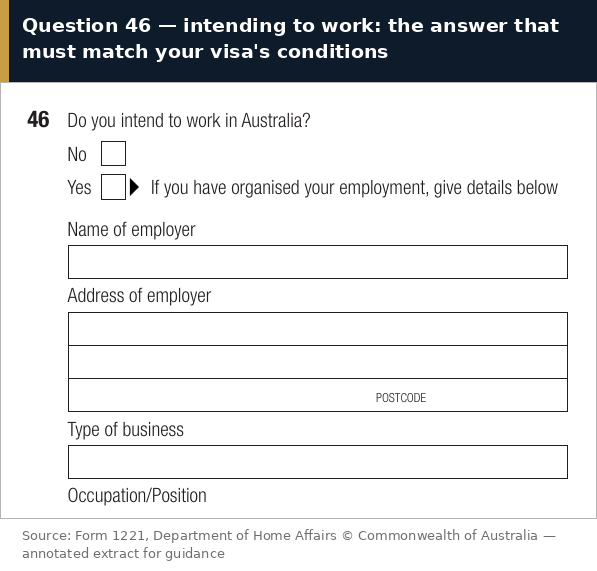
A one-tick question with visa-defining consequences. Your answer must match what your visa actually permits. A visitor visa applicant ticking "yes" has just told the Department their intention is inconsistent with the visa they are applying for; a skilled applicant with organised employment should complete the employer details fully and consistently with the nomination. Answer truthfully — always — but understand what the question is testing before you answer it, and if your true answer creates a problem, the problem is with the visa choice, not the form. That is a conversation to have before lodgement.
Completing and lodging it
Practical rules that save weeks: complete it electronically rather than by hand; use Part O generously to explain estimated dates or unobtainable details; sign and date the declaration; keep a copy permanently; and lodge it against the application in ImmiAccount — or have your representative under a Form 956 lodge it and keep the acknowledgement. If your circumstances change after lodgement, that is a Form 1022 notification, not a fresh 1221.
For character-heavy cases, Form 1221 often travels with Form 80 and the Form 1399 armed forces declaration as a trio — three documents, one life story, zero tolerance for variation between them.
If you have been asked for a Form 1221 and your history has anything that needs careful presentation — employment gaps, complicated travel, an inconsistency with something already lodged — book a $97 10-minute chat with me before it goes in.
Frequently asked questions
Do I need both Form 80 and Form 1221?
Complete whichever the Department requests. If both are requested, complete both — and make them perfectly consistent with each other and with your application. Neither substitutes for the other.
What is the difference between Form 80 and Form 1221?
Form 80 is the long character and security questionnaire. Form 1221 is shorter and broader-purpose, with more focus on your intended activities in Australia. They overlap substantially, which is exactly why consistency between them matters.
How far back does Form 1221's employment history go?
The form asks for your entire employment history — including internships, work experience, self-employment, and an account of how you spent any periods of unemployment.
Who has to complete Form 1221?
Anyone the Department asks, typically under a s 56 request or a checklist for the visa type. Each person completes their own form.
What happens if my Form 1221 doesn't match my Form 80?
Discrepancies invite requests for comment and can ground a PIC 4020 finding for misleading information, which generally carries a three-year bar. Build both forms from one master chronology.
Can I add explanations to Form 1221?
Yes — Part O (Additional details) exists for exactly that. Use it to explain estimated dates, name variations or anything a case officer might otherwise query.
Asked for a 1221 and want it done once, correctly? Book your $97 10-minute chat or engage me at myvisa.com.au/work.