Your visa application is lodged. Then life happens — you move house, you marry, a baby arrives, you change passports. Form 1022 is how you tell the Department of Home Affairs, and telling them is not optional. It is a statutory duty, and the cost of ignoring it can be the visa itself.
Here is how the obligation works, how it differs from Form 1023, and what the form actually asks.
1. What Form 1022 is, and the section 104 duty
Form 1022, officially titled Notification of changes in circumstances (Section 104 of the Migration Act 1958), is the Department's form for reporting that an answer you gave on your application form is no longer correct because your circumstances have changed.
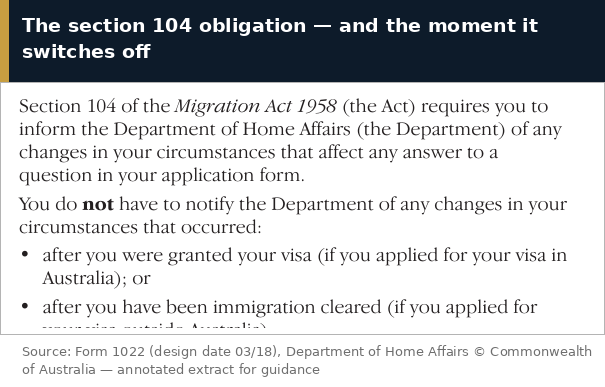
The duty comes from the Migration Act 1958 (Cth) s 104: if circumstances change so that an answer on your application form is incorrect in the new circumstances, you must inform the Department in writing as soon as practicable. The form is the standard way to discharge that duty, and its own opening text sets out both the obligation and its limits.
Download the current form only from the official source: Form 1022 on the Department of Home Affairs website.
2. When the duty applies — and when it switches off
The timing rules are precise, and they are the part people get wrong. Under s 104:
- If you applied in Australia, the duty covers changes that occur before your visa is granted. Once granted, s 104 no longer requires notification for that application.
- If you applied outside Australia, the duty runs from lodgement until you are immigration cleared on arrival — so it continues after grant. An offshore partner visa applicant whose circumstances change between grant and first arrival must still notify.
If you are unsure whether the duty still applies to you — the onshore/offshore distinction, or whether a later obligation such as a sponsor's own notification duty applies — get advice rather than assume it has switched off.
3. What changes must be notified
The section 104 duty is triggered whenever a change makes an answer on your application incorrect. Common examples:
- a new residential address;
- a new passport;
- a change in relationship status (marriage, separation, a new de facto relationship);
- the birth of a child (see section 5);
- a change of employment where your application relied on it; and
- the death of a person included in the application.
For a simple change of address or passport details on its own, the Department also has a dedicated form — Form 929. Where the change affects the answers on your application more broadly, Form 1022 is the correct instrument. If you are not sure which applies, that is a question worth asking before you lodge.
4. Form 1022 versus Form 1023 — changed versus wrong
The two forms are siblings, and the line between them is the whole point.
- Form 1022 is for information that was true when you gave it but is no longer current. You lived at that address; now you don't.
- Form 1023 — Notification of incorrect answer(s) — is for information that was wrong when you gave it.
The distinction matters more than it looks. Using Form 1022 to quietly "update" an answer that was never true does not cure the original incorrect answer — and incorrect answers can engage the cancellation power in s 109 of the Migration Act 1958 (Cth), as well as Public Interest Criterion 4020 for the application itself. Whether your situation is a change or a correction is a legal judgment with real consequences — if there is any doubt, get advice before you lodge either form, rather than choosing the form yourself.
Unsure whether it is a change or correction? Book a consultation before lodging.
5. Adding a newborn or dependant to a pending application
The single most common Form 1022 event in a partner visa matter is a birth. Notifying the birth on Form 1022, with the birth certificate, is how a baby born while an application is pending is added to that application so the child can be considered — usually alongside the parent. Lodge it promptly. Other dependants whose circumstances change may also need to be notified. Where adding a family member is not straightforward, get advice before lodging.
6. What the form asks, and how to lodge it
The form is short: your details, details of any partner or dependants included in the application, the changes, your visa or application details, and a declaration. The heart of it is Question 14 — a two-column table.
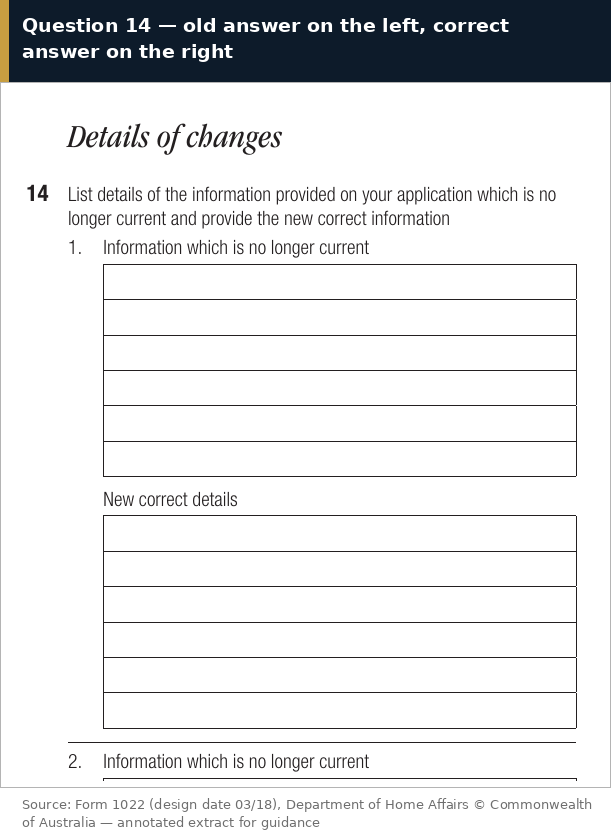
For each change, the table asks for the information which is no longer current (as it appeared in your application) beside the new correct details. A vague entry forces a case officer to write back, and every request for information adds time — so give complete, specific details, and attach the supporting document (the new passport biodata page, the birth certificate, the marriage certificate). The form allows additional pages if the table runs out of rows.
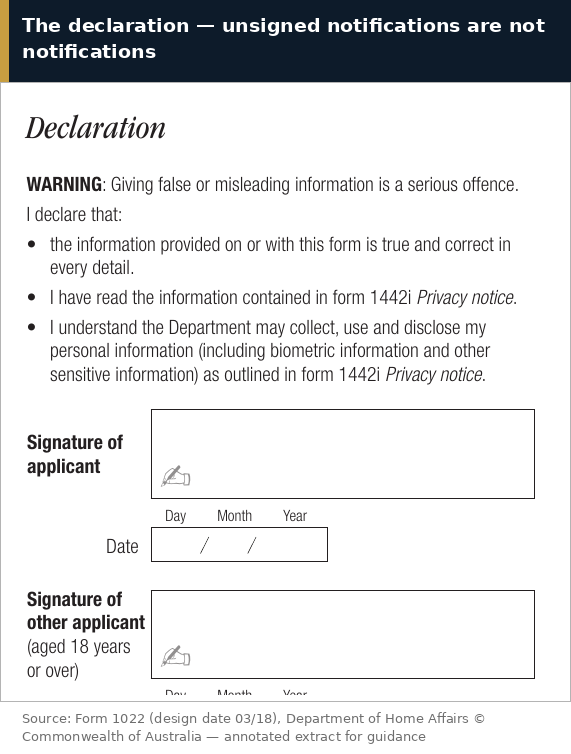
The declaration warns that giving false or misleading information is a serious offence, and the details you give on this form are themselves answers to which the Act applies. Sign it, date it, and keep a copy — this form becomes part of the record every later application is checked against, including Form 80 if character processing follows.
Lodging: for online applications, upload the completed form through ImmiAccount against the live application — many changes (address, passport) can also be made directly through ImmiAccount's update details function, which satisfies the written-notice requirement. For paper applications, send it to the office processing your application. If a representative acts for you under a Form 956, they lodge it and keep the acknowledgement.
7. What happens if you don't notify
Non-compliance with s 104 has teeth. A visa granted while the Department held outdated answers is liable to cancellation under the Migration Act 1958 (Cth) — the form's own warning pages spell out the consequences, including that cancellation onshore can make you an unlawful non-citizen. Cancellation is not automatic, and you would ordinarily be given the chance to comment first, but it is a position best avoided — and if a visa cancellation is on foot, get advice immediately.
I have never seen a client harmed by notifying a change promptly; I have repeatedly seen the opposite — the unreported separation, the address change that meant a notice went astray, the newborn nobody mentioned, each small and each expensive to fix later. If a change has happened and you are unsure whether, or how, to report it — particularly where it touches your relationship, or where the "change" is really a correction — book a $97 10-minute chat with me before you lodge anything. You can also read how I help with documentation problems in an application.
Frequently asked questions
When do I need to use Form 1022?
Whenever circumstances change so that an answer on your visa application form is no longer correct — a new address, passport, relationship status, or a new child — while the s 104 obligation applies to you: before grant for onshore applicants, and until immigration clearance for offshore applicants.
What is the difference between Form 1022 and Form 1023?
Form 1022 reports information that was true but has changed. Form 1023 corrects information that was incorrect when given. Using 1022 to patch an originally wrong answer does not fix it and can leave s 109 cancellation exposure in place. If in doubt whether yours is a change or a correction, get advice before lodging.
Do I use Form 1022 for a newborn baby?
Yes. Notify the birth on Form 1022 with the birth certificate so your child is added to the pending application and can be considered alongside you.
Is there a deadline for Form 1022?
The Act requires notification "as soon as practicable" after the change. There is no fixed number of days — which means promptly, and before the Department finds out another way.
Do I need Form 1022 after my visa is granted?
If you applied in Australia — no, the s 104 duty ends at grant. If you applied overseas, the duty continues until you are immigration cleared on arrival. Separate obligations, such as a sponsor's own notification duties, can apply beyond that.
Something changed mid-application? I am an admitted solicitor and Australian legal practitioner. Tell the Department once, correctly. Book your $97 10-minute chat or engage me at myvisa.com.au/work.