Form 956 looks like the simplest document in your visa application. It is also the one that decides who the Department of Home Affairs talks to about your case — and a mistake here means notices going to the wrong person while your deadlines quietly run.
I have completed this form many times in my immigration practice. Here is what it actually does, how it differs from Form 956A, and where people get it wrong.
1. What Form 956 is — appointment of a representative
Form 956 tells the Department who is representing you and authorises that person to deal with the Department on your behalf — to receive your correspondence and act for you in the matter.
"Immigration assistance" is a defined concept under the Migration Act 1958 (Cth) s 276 — helping to prepare or lodge a visa application, or advising about it. The law limits who may lawfully provide it to three distinct categories: an Australian legal practitioner; a registered migration agent, who is registered under the migration-agent scheme rather than admitted as a lawyer; and an exempt person, such as a close family member or sponsor, who may assist but must never charge a fee. I act in the first of those categories: I am an admitted solicitor and Australian legal practitioner, not an agent. Form 956 is how any of them is put on the record for your matter.
Download the current form only from the official source: Form 956 on the Department of Home Affairs website.
One point worth stating plainly, because it confuses many applicants: since 22 March 2021, Australian legal practitioners have not been required to hold separate agent registration to give immigration assistance — a lawyer is authorised as a lawyer. On the form, a legal practitioner records that capacity and provides a Legal Practitioner Number (LPN), a number the Department issues to lawyers; the separate agent-registration number field does not apply to a lawyer and is left blank. If you are unsure in what capacity your representative is acting, ask them before you sign.
2. Form 956 versus Form 956A — the difference
This is the distinction that trips people up, so here it is in two lines.
- Form 956 appoints a representative to give you immigration assistance and deal with the Department for you. It is about representation — your lawyer receives the correspondence and can advise you and act on the matter.
- Form 956A, officially Appointment or withdrawal of an authorised recipient, appoints someone only to receive communications — a spouse, relative or friend who is not providing immigration assistance. The Department cannot discuss the merits of your case with a 956A recipient; they are a mailbox, not a mouthpiece.
If you have engaged a lawyer, one Form 956 does both jobs — it appoints them to assist you and directs correspondence to them. You do not lodge a 956A on top. The 956A exists for the unrepresented applicant who simply wants, say, an onshore relative to receive the mail. And if a friend "helping with the forms" starts advising you on what to write, they have crossed from authorised recipient into immigration assistance — which they may only give if they are authorised to, and never for a fee unless they are a lawyer or authorised professional.
3. When and how to lodge it
Lodge Form 956 against the live application, not into a general inbox. In practice that means uploading it through ImmiAccount against your application, or lodging it together with the application itself, and keeping the acknowledgement.
Question 1 routes the form: it asks whether this is a new appointment or the end of an appointment, and that choice determines which parts you complete.
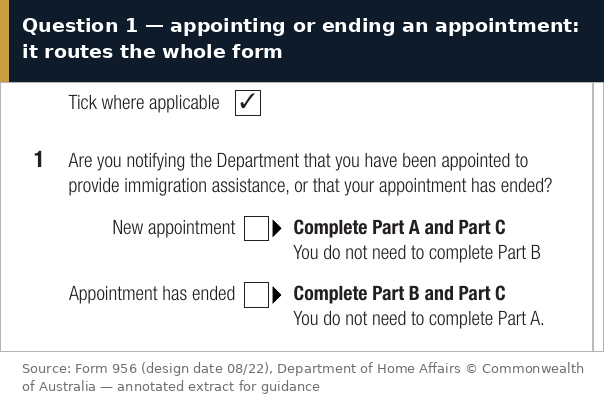
Tick new appointment and you complete the parts the form directs for a new appointment; tick appointment has ended and you complete the parts for ending one. Completing the wrong parts — or all of them, as anxious applicants often do — can leave the Department treating the form as ambiguous. If you are not sure which parts apply to your situation, get advice before lodging.
4. What appointing a lawyer changes about how your matter is run
Once a Form 956 is recorded, the Department's correspondence goes to your representative. Two questions on the form control this and deserve care:
- Question 7 records the representative's consent to electronic communication and their email address — which, in practice, is how virtually every notice now arrives. One wrong character can send a s 56 request for information to the wrong place while your deadline runs.
- Question 15 defines the scope — the appointment is matter-specific and allows one tick only.
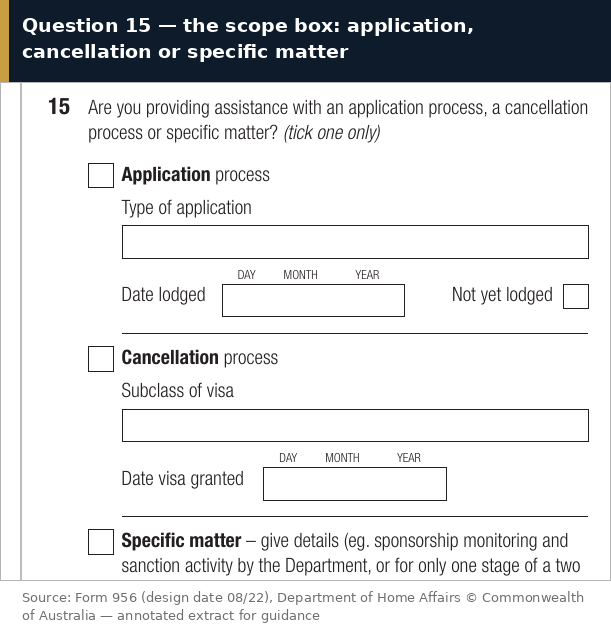
Application process covers a visa application; cancellation process covers a visa being considered for cancellation; specific matter covers everything else (the form gives sponsorship monitoring and ministerial intervention as examples). Scope matters in practice: a 956 lodged for your visa application does not automatically put your lawyer on the record for a cancellation notice that arrives later — that is a fresh form.
A related question, Question 17, asks whether your representative is also your authorised recipient. Where that applies, the Migration Act 1958 (Cth) s 494D treats documents given to that person as given to you — which is what starts your review clock on deemed receipt, not on the day you happen to read the letter. That is a reason to have a represented file watched closely, and to get advice the moment a decision arrives.
5. Step-by-step completion
- Answer Question 1 — new appointment, or ending one — and complete only the parts it directs.
- Record the representative's details and capacity, including the email at Question 7 (check every character).
- Set the scope at Question 15 — one tick, matched to your actual matter.
- Decide Question 17 (authorised recipient) with your representative, understanding the deemed-receipt effect above.
- Both sides sign Part C — the representative signs their declaration and you sign the client declaration; for a child under 16 a parent or guardian signs; for a company sponsor, someone with authority to bind the company signs.
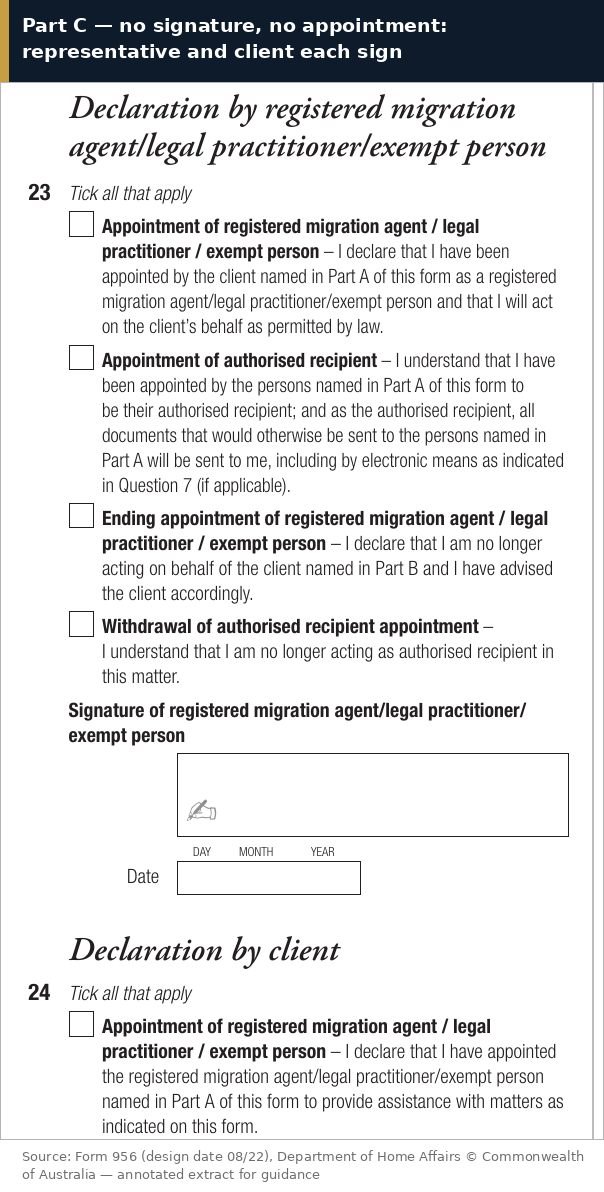
Unsigned or part-signed 956s are the single most common reason an appointment is not recorded. Sign and date in ink or by an accepted electronic signature, and keep the dates consistent — a representative's declaration dated before the client's has raised departmental queries. Make sure your name on the form matches your application and passport exactly; a mismatch can leave the Department unable to link the authority, and correspondence defaults back to you. If your details change mid-application, that is a Form 1022 (a change in circumstances) or a Form 1023 (an answer that was wrong when given).
6. Withdrawing or changing a representative
The appointment does not expire — it runs until it is withdrawn, replaced, or the matter concludes. If you change representatives, a new Form 956 appointing the new representative supersedes the old appointment once it is lodged against your application; you do not need a separate withdrawal first, but confirm the change has actually been recorded. If you simply part ways with a representative and lodge nothing, the Department may keep writing to them while your deadlines run — so lodge the change.
Form 956 also stops at the Department's door. Review before the Administrative Review Tribunal needs its own appointment — Form MR5 — and Federal Court proceedings need a separate notice of acting. Appointing me on a 956 does not, by itself, put me on the record for your visa refusal appeal.
7. Why appoint an admitted solicitor to act for you
I am an admitted solicitor and Australian legal practitioner. When a Form 956 puts a lawyer on your file, what you tell me is covered by legal professional privilege, the Department's correspondence — the s 56 requests, the invitations to comment, the decision — lands on a lawyer's desk the day it issues, and if the matter has to move beyond the Department to the Tribunal or the courts, one adviser carries it through. It sits alongside your identity-heavy documents such as Form 80 and Form 1221, where consistency across every document is what protects you from Public Interest Criterion 4020 trouble.
If you want the comfort of knowing every notice lands on a lawyer's desk the day it issues, book a $97 10-minute chat with me.
Frequently asked questions
What is Form 956 for?
Form 956 appoints a representative to give you immigration assistance and to deal with the Department of Home Affairs on your behalf — receiving your correspondence and acting on the matter. It is how your lawyer is put on the record for your file.
What is the difference between Form 956 and Form 956A?
Form 956 appoints a representative — such as your lawyer — who can both receive the Department's correspondence and advise and act for you. Form 956A appoints an authorised recipient, who only receives correspondence and cannot advise you or discuss the merits of your case. If a lawyer acts for you, one Form 956 covers both; you do not also lodge a 956A.
Do I need to lodge Form 956 to have a lawyer act for me?
Yes. Until a Form 956 is lodged against your application, the Department deals with you directly and sends correspondence to you. Lodging it — through ImmiAccount against the live application, or with the application itself — is what puts your lawyer on the record and directs the notices to them.
Can I withdraw or change a Form 956 appointment?
Yes. A new Form 956 appointing a new representative supersedes the previous appointment once lodged against your application, and an appointment can be ended using the form's "appointment has ended" option. Confirm with the Department that the change has been recorded, rather than assuming it.
Does lodging Form 956 cost anything?
The Department does not charge a fee to lodge Form 956 itself. Any cost is the professional fee of the representative you appoint — and an exempt person, such as a close family member, must never charge a fee for immigration assistance. Ask your representative about their fees before you sign.
Need Form 956 done properly the first time? I am an admitted solicitor and Australian legal practitioner, and I act for visa applicants and sponsors nationwide from eight locations. Book your $97 10-minute chat — or if you are ready to engage, start at myvisa.com.au/work.