
On This Page...
ToggleBridging Visa in Australia: The Complete Guide for Applicants
By Nilesh Nandan — Australian Immigration Lawyer, MyVisa® Immigration Lawyers
This blog is intended for discussion purposes only and does not constitute advice. You should seek independent legal advice before relying on any information provided on this site.
Immigration policies, systems, and processes can change without notice. I’d like to know your own experience with the immigration challenges noted above — feel free to contact me.
Table of Contents
Introduction & Why This Matters
As an immigration lawyer, I often see clients become anxious when their current visa is nearing expiry, or when they must wait for a decision on a new visa application. In these critical moments, knowing how a **Bridging Visa** works—its types, conditions, rights and the strategic choices—can literally mean the difference between staying lawful or becoming unlawful.
In this guide, I’ll walk you through everything you need to know about Bridging Visas in Australia: how to choose the right subclass, preserve your work rights, travel safely, avoid mistakes, and use it as a bridge (not a trap).
This is general information in my voice as your adviser. For a personalised assessment, always consult directly with me or an immigration specialist.
What Is a Bridging Visa?
In simple terms, a **Bridging Visa** is a temporary visa granted to allow someone to stay lawfully in Australia while waiting for resolution of their immigration status — whether that be the grant of a new visa, an appeal decision, or arranging departure.
It is not a substantive visa (i.e. not your final student visa, partner visa, skilled visa). Rather, it “bridges” the gap between your existing visa (or no visa) and your next visa outcome.
The Australian Department of Home Affairs states that bridging visas “let you stay in Australia lawfully while your immigration status is resolved.”
A bridging visa typically comes into effect when your current substantive visa ends. Until then, you must abide by the conditions of your existing visa.
Be aware: **not every situation gives you automatic entitlement** to a bridging visa — sometimes you must apply, and sometimes your status may be restricted (e.g. work or travel).
Types & Comparison of Bridging Visas (A, B, C, E)
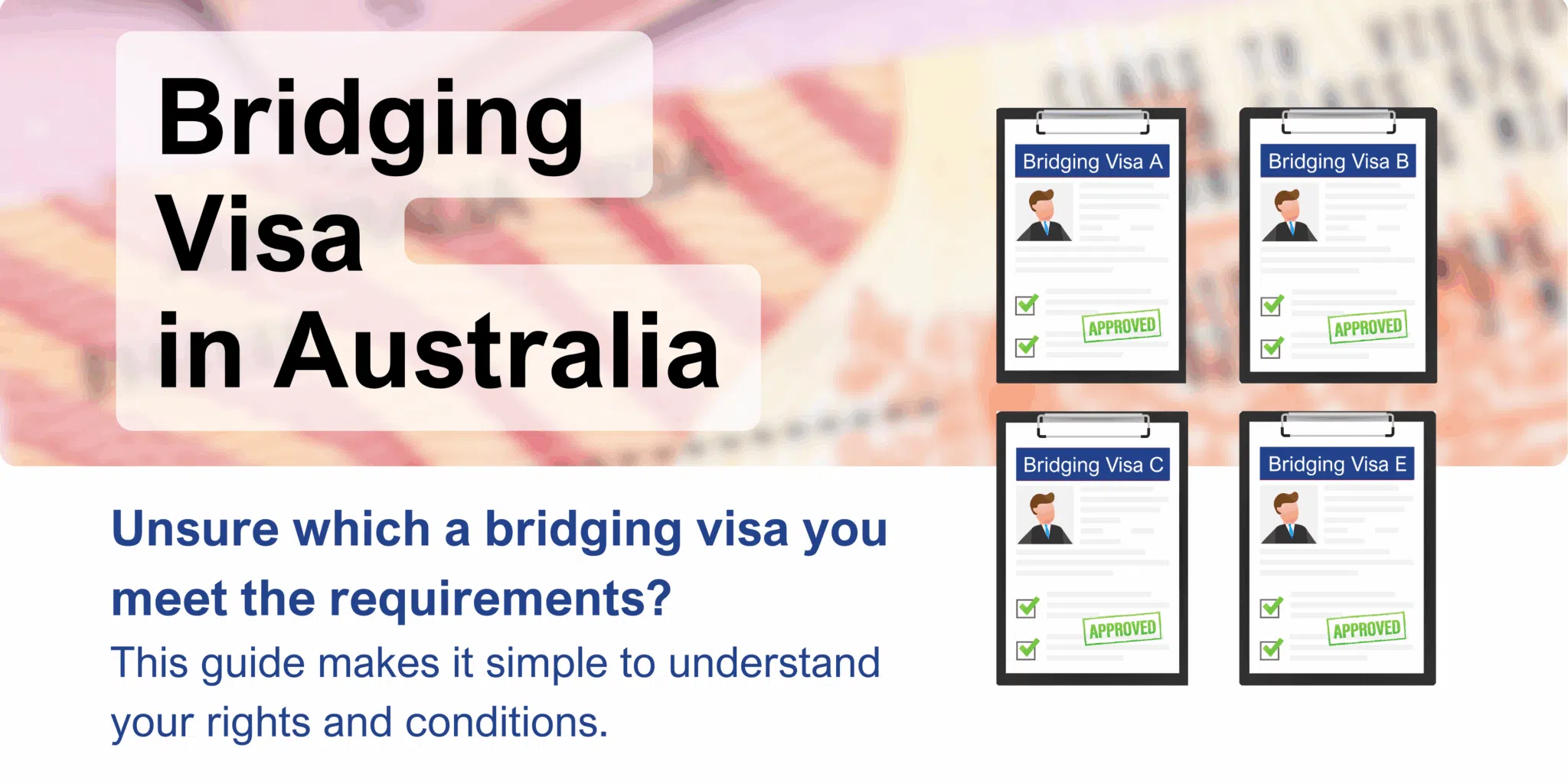
Australia currently offers several bridging visa subclasses. The most common are:
- Bridging Visa A (Subclass 010)
- Bridging Visa B (Subclass 020)
- Bridging Visa C (Subclass 030)
- Bridging Visa E (Subclasses 050 / 051)
- Occasionally, Bridging Visa D is mentioned in migration commentary as a very short-term option; however, it’s rarely used in standard application pathways.
Here is a comparison table summarising the main features of each subclass:
| Subclass | When It’s Used | Work Rights / Conditions | Travel Rights | Notes & Limitations |
|---|---|---|---|---|
| Bridging Visa A (010) | When you apply for a substantive visa while holding a valid visa | May inherit previous visa’s work rights; or “no work” condition may apply | Leaving Australia cancels the BVA (unless you obtain a BVB) | Common bridging visa; doesn’t permit travel unless changed to BVB |
| Bridging Visa B (020) | When you want to travel overseas while your substantive visa is processing | Typically inherits work rights (subject to conditions) | Allows re-entry within a defined travel window | You must apply for it before leaving Australia; limited travel period |
| Bridging Visa C (030) | When you apply for a substantive visa after your previous visa has expired (i.e. you are technically unlawful) | No automatic work rights; may apply for work if financial hardship is shown | Leaving Australia cancels the BVC | Often used for people who have overstayed; conditions stricter |
| Bridging Visa E (050 / 051) | When you are unlawful, visa expired, or awaiting review/decision | Usually no work rights; may apply in limited circumstances | No travel rights — leaving cancels the visa | Often a fallback or regularisation option; more restrictive |
This table is a starting point — in each subclass, **conditions and entitlements may differ depending on your circumstances and the discretion of Home Affairs**. Always check your visa grant notice and VEVO for your exact conditions.
Eligibility & Key Conditions for Each Type
Bridging Visa A (010)
The BVA is the default bridging visa in many cases. To be eligible, you must:
- Be in Australia at the time of application and at grant.
- Have lodged a valid application for a substantive visa while your existing visa is still in effect (or very shortly after it expires).
- Meet relevant health, character and other visa requirements if requested.
The visa may be granted with “no work” conditions. You may apply to have that condition lifted in certain situations such as financial hardship.
Note: From 1 August 2022, BVA (and BVB, BVC) applications must be lodged through ImmiAccount or via online form — paper or in-person forms are no longer accepted.
Bridging Visa B (020)
This subclass is used when you need to travel while your substantive visa is pending. Key points:
- You must be in Australia when applying.
- Generally, you already hold a BVA or substantive visa application in process.
- You must submit your travel reasons and itinerary, and satisfy Home Affairs that travel is justified.
- The visa will include a “travel period” during which you may depart and re-enter Australia.
If you leave after that travel window expires, your BVB will end, and your substantive visa application may be jeopardised.
Bridging Visa C (030)
BVC applies when your previous visa has expired and you lodge a new substantive visa. Conditions include:
- You need to be in Australia at the time of grant.
- No automatic work rights. You may apply for work permission by proving financial hardship or other compelling reasons.
- Leaving Australia terminates the visa.
Bridging Visa E (050 / 051)
The BVE is for people who are out of status or awaiting review. Key eligibility criteria include:
- You must be present in Australia when applying.
- You may be applying because your visa expired, you’re unlawful, or pursuing judicial review or Ministerial intervention.
- You must comply with all laws during the bridging visa period.
The BVE typically carries more restrictive conditions (no travel, restricted or no work) and is often used as a fallback while reorganising your legal status.
Other Notes & Special Conditions
– In rare commentary, a “Bridging Visa D” is mentioned as a short bridging visa (for technical issues) but this is seldom used in standard immigration practice.
– If your current substantive visa is **cancelled** before a bridging visa can take effect, then your bridging visa may not come into effect, and you may become unlawful.
– When applying for judicial review or appeal, a bridging visa may be extended to cover that period, depending on your circumstances.
– Always check your grant letter and VEVO to see which conditions apply (e.g. “no work”, “must stay at address”, “reporting obligations”).
Work Rights, Travel Rights & Other Entitlements on a Bridging Visa
Work Rights
Whether you can work on a bridging visa depends heavily on the subclass and the specific conditions imposed.
- **Bridging Visa A / B**: If your previous substantive visa allowed work, often you inherit those work rights. But if your bridging visa has a “no work” condition, you may apply to have it lifted by demonstrating financial hardship or special circumstances.
- **Bridging Visa C**: No automatic work rights. To gain work rights, you must apply and often must show financial hardship or compelling reasons.
- **Bridging Visa E**: Generally no work rights. In rare cases, the Department may allow work if you can present a strong case (e.g. severe hardship) or when previously granted permission, but it is discretionary.
One important condition to note: if your bridging visa carries **condition 8547**, limiting work to six months with the same employer, you may need to apply for a new bridging visa to remove that condition.
To confirm your current work entitlements, always check VEVO and your visa grant notice.
Travel Rights
Travel rules are stricter than work rights — bridging visas generally do **not** allow you to leave and return to Australia, except for **Bridging Visa B** (BVB).
- **BVB**: permits you to depart and re-enter within the “travel period” granted. If you travel outside that window, your BVB will cease and your substantive visa application may be affected.
- **BVA, BVC, BVE**: leaving Australia typically cancels the bridging visa (and might void your visa application).
Always apply for a BVB **before** you depart — leaving first may mean you lose the ability to return.
Other Entitlements & Conditions
– Some bridging visas may have reporting requirements (you must notify Home Affairs of changes in address, contact details).
– You must obey all Australian laws while your bridging visa is active. Non-compliance can lead to cancellation.
– In certain cases (e.g. subclass 051 BVE), special rules may apply for asylum or protection visa applicants.
– Medicare and access to social support generally do *not* extend to bridging visa holders. Recent regulatory changes may apply in special humanitarian contexts (e.g. for visa holders from Gaza/Israel) but these are exceptional.
How to Apply: Steps, Checklist & Practical Tips
General Application Steps
- Determine which bridging visa subclass fits your situation (A, B, C, E).
- Gather required documents: identity, previous visa, proof of substantive visa application, evidence of hardship or travel reasons if needed.
- Log into your ImmiAccount or use the online webform (for BVA, BVB, BVC).
- Complete the relevant application form (e.g. Form 1005 for A/B/C, 1006 for B, or use departmental instructions for E).
- Attach supporting evidence (financial documents, travel itinerary, appeal documents, etc.).
- Submit the application online or via webform, pay any fee (if applicable).
- Wait for the grant decision (no published processing times).
- Once granted, comply with all conditions while your bridging visa is in force.
Checklist: Documents & Evidence You Should Prepare
- Current passport or identity document
- Details of your last visa (visa grant letter, visa status)
- Proof of substantive visa application (application number, receipt, confirmation)
- Evidence of financial hardship (bank statements, expenses, debts)
- Travel itinerary, reason for travel (if applying for BVB)
- Any appeal, review or judicial review documents (if relevant)
- Residential address and contact details in Australia
- Police checks or character documents if required
- Any forms (Form 1005, 1006 or departmental E forms) completed and signed
Specific Forms & Technical Notes
– **Form 1005** is used to apply for or vary Bridging Visa A, B or C.
– **Form 1006** is used for Bridging Visa B (travel) applications.
– For BVE, there is no standard online form in some cases; require departmental instructions.
– Note: from August 2022, in-person or paper applications for BVA, BVB, BVC are no longer accepted — you must apply online.
Processing Times & What to Expect
The Department does not publish fixed processing times for bridging visas.
The decision timeframe depends on:
- The complexity of your case
- The completeness and quality of your supporting documents
- Workload at the Department of Home Affairs
- Whether additional health, character or security checks are needed
After submission, you can monitor progress via ImmiAccount or contact your case officer if delays are excessive.
Tips to Improve Success & Speed
- Double-check all identity and substantive visa details to avoid mismatches.
- Include a cover letter explaining the purpose, especially for travel or hardship requests.
- Provide clear and organised supporting evidence (labelled, dated, translated if needed).
- Avoid submitting multiple bridging visa applications — this can delay processing.
- Respond promptly to departmental requests for further information.
- Keep copies of all documents and submissions.
Common Pitfalls & Mistakes to Avoid
Even a small oversight can jeopardise your bridging visa or later visa outcomes. Here are some traps I see frequently:
- Leaving Australia before getting a BVB or while holding BVA, BVC or BVE — this often cancels your bridging visa.
- Assuming work rights just because the previous visa had them — always check conditions on the bridging visa grant.
- Submitting incomplete or contradictory documents (e.g. wrong name spelling, missing address proof).
- Delaying lodging your substantive visa application until your visa expires — this forces you into BVC or BVE with more restrictions.
- Applying multiple bridging visas or re-submissions — delaying process.
- Overstaying travel windows or ignoring travel conditions on BVB.
- Failing to keep Home Affairs updated about changes in address, contact or circumstances.
- Missing deadlines for lodging appeals or judicial review while under bridging visa status.
- Ignoring any “no work” condition without applying for its removal if you need to work.
Always err on the side of caution: check your bridging visa conditions, act before deadlines, and if in doubt, consult me.
Client Scenarios & Illustrative Examples
Example 1: From Student to Partner Visa
Asha was on a student visa, and prior to its expiry she lodged a partner visa application. A Bridging Visa A was granted automatically. While waiting, she continued study and part-time work under inherited conditions. She did not seek travel, so she did not apply for BVB. Eventually her partner visa was granted, at which point her bridging visa ceased.
Example 2: Needing to Travel Mid-Process
Ravi held a Bridging Visa A but needed to visit family overseas. He applied for a Bridging Visa B ahead of travel, specifying purpose and travel dates. Then was given a travel window of eight weeks. He departed and returned within that window, and resumed waiting for his substantive visa outcome.
Example 3: Overstayed & Regularising with BVC + Work Permission
Chen’s visitor visa expired, but he lodged a skilled visa application late. He was granted a Bridging Visa C (with no work rights). He then applied to remove the “no work” condition, presenting financial hardship evidence, and was granted permission to work while the application proceeded.
Example 4: Protection / Asylum Claim with BVE
Miriam arrived without proper clearance and applied for a protection visa. She was granted a Bridging Visa E subclass 051 while her claim was under review. She could not travel or work but remained lawful in Australia until the protection decision was made.
Example 5: Visa Refusal & Maintaining Legal Status
Ahmed’s application for a skilled visa was refused. He held a Bridging Visa at the time, and he lodged a review at the Administrative Appeals Tribunal (AAT). His bridging visa remained valid during the appeal period, allowing him to stay while the review proceeded.
Frequently Asked Questions
- Can I work on a Bridging Visa?
- It depends on your subclass and visa conditions. Some bridging visas inherit work rights from your prior visa; others carry a “no work” condition. You may apply to remove that condition if you can show financial hardship.
- Can I travel on a Bridging Visa?
- Only Bridging Visa B (BVB) explicitly permits travel and return to Australia within a defined travel window. Other subclasses will generally cease if you leave Australia.
- What happens if my substantive visa application is refused?
- Your bridging visa usually continues (if granted) while you appeal or seek judicial review, subject to its conditions. But you must act within the time limits.
- Does leaving Australia cancel my bridging visa?
- Yes — for most bridging visa subclasses (A, C, E), leaving Australia will cancel that visa. Only BVB is designed to allow travel.
- How long is a Bridging Visa valid?
- Your bridging visa stays valid until the Department decides your substantive visa, finalises your appeal or review, or you depart Australia (if allowed).
- Can I change conditions (e.g. add work rights)?
- In many cases, yes. You may apply to vary conditions (remove “no work”, adjust travel permission) if you can show hardship or a compelling reason.
- What does it cost to apply?
- Most bridging visas are **free** to apply for. Fees may apply in some cases (e.g. BVB travel applications).
Conclusion & What You Should Do Next
A Bridging Visa can be a lifeline in your visa journey — helping you remain lawful, preserving work entitlements (in many cases), and, in certain subclasses, allowing limited travel. But it’s not foolproof: incorrect subclass selection, breach of conditions, or failing to act in time can ruin your immigration pathway.
As your immigration lawyer, I can help you review your options, choose the correct bridging subclass, prepare strong supporting evidence, and ensure you remain lawful throughout the process.
If you’d like personalised advice or help lodging or reviewing your bridging visa (or dealing with complications), book a consultation with me today to discuss your visa situation.
Immigration policies, systems, and processes can change without notice. I’d like to know your own experience with the immigration challenges noted above — feel free to contact me.
Legal Disclaimer
This blog is intended for discussion purposes only and does not constitute advice. You should seek independent legal advice before relying on any information provided on this site. Immigration policies, systems, and processes can change without notice. I’d like to know your own experience with the immigration challenges noted above — feel free to contact me.
MyVisa: Nilesh Nandan, Attorney at Law
BBus(Accy) LLB(QUT) GDLP MBA(IntBus)
Head of Practice


704 Responses
Hi Nilesh,
Thanks for taking time out to help people with their queries.
I have an urgent matter related to my visa. I have made a valid application for protection visa subclass 866 well before my current visa expires. The validity of my visa application has been confirmed by the department itself on phone call and i have triple checked everything myself.
My current visa expired on 2nd of may and i have not been granted a bridging visa yet and its been 3 weeks since my last visa expired. I have made a separate bridging visa application as well before the expiry of my previous visa.
I have made several calls to the department and they have asked me to wait until my case officer checks the documentation and issues a bridging visa. They have asked me not to make any application for BVE as i won’t be able to go back to BVA then.
I’m happy to wait but the only problem is, my employer has put me on unpaid leave until my visa shows up on VEVO. I had full work rights on my previous visa and was working full time. But now i do not have any visa associated with my name and cannot work. I have a family, a kid 3 years old who was born here and we have exhausted our savings by paying bills and rent among other things. I only have $200 to my name at the moment and my rent is due again next week. I am literally stuck and the department wont let me see anyone face to face, they just ask me to wait until my case officer contacts me.
Please advice what should i do?
Hi Nilesh!!
I applied for covid 408 visa last June and got a bridging A. Since then I have applied for 190, received an inactive BVC and requested 408 to be withdrawn.
408 withdrawal has not yet been processed so still on a BVA awaiting my 190.
What do you think my options are for travel and applying for a BVB? Would I remain on BVB if 408 was processed before 190 or automatically go into BVC
Appreciate any insight!!
Hi Nilesh!!
I applied for covid 408 visa last June and got a bridging A. Since then I have applied for 190, received an inactive BVC and requested 408 to be withdrawn.
408 withdrawal has not yet been processed so still on a BVA awaiting my 190.
What do you think my options are for travel and applying for a BVB? Would I remain on BVB if 408 was processed before 190 or automatically go into BVC
Appreciate any insight!!
I got a BVB till 22nd May 2022 I was travelling back on 13th May 2022 but tested positive for covid and had to wait for a week to travel back I am travelling from India today will there be any issue and reach tomorrow will there be an issue?
When you say you will arrive back tomorrow I assume that is 23rd May and not 22nd May. As you have explained your bvb expires on 22nd May you will be stopped at the airport if you arrived after midnight on 22nd May.
This will be an issue and has some potentially devastating consequences forward you should seek more complex advice.
I understand that becoming infected with covid-19 was completely outside of your control. Unfortunately this is not relevant in relation to any automatic extension to the return facility attached to your bridging visa B class 020.
I’m sorry that the news is not more fruitful for you but I hope that it does help you get clarity with your position.
You can book in here: https://myvisa.com.au/10-minute-chat/
Regards
Nilesh Nandan
Immigration Lawyer
MyVisa.com.au/about
Sneha, I rely on honest reviews. Could you please review this service?
https://search.google.com/local/writereview?placeid=ChIJkeLlu9W6MioRuQhOfXO6z4c&source=g.page.m.rc
Hi,
I’m currently on BVA and planning to apply BVB in order to go back to my home country for like 3 weeks.
With the current COVID travel exemption, is BVB now allow to re-enter Australia.
I’m aware that in the past when Australia open the border, they allow international student and those on working visa.
But there’s no information regarding BVB
Thank you
No problem here.
Travel home for three weeks shouldn’t be a problem.
I’m going to see in that the bvA is in association with a subclass 485 visa? Correct. When do old you know the substantive visa.
I no ask this because if grant is close, simply wait until grant and then travel.
Regards
Nilesh Nandan
Immigration Lawyer
MyVisa.com.au/about
I have applied for a Bridging Visa A while a decision is being made with my Substantive Visa (Partner Subclass 309/100) is being processed. I am currently in Australia and I will need to leave, according to my ETA Visa on July 4.
Can you advise how long processing times are normally for the Bridging Visa A to be granted? Average time? I filed an application for my Bridging Visa on May 18, 2022.
Hi Dianne
Yours is an interesting case because normally you will not get a bridging visa granted in relation to an offshore application.
If indeed you are eligible ( perhaps because of a COVID 19 concession), then you can expect to receive a confirmation and grant letter in around 2 weeks.
I know you were worried that you might not receive anything until after midnight on the 4th of July.
Provided you have made a valid application for the bridging visa and it is something that you are eligible for then it doesn’t matter whether processing takes place before or after the 4th of July.
Your ETA period will end at midnight on the 4th of July and yes you will hold no visa until such time as the Department makes the decision in relation to the bridging visa grant.
This happens all the time and is fixed when the department actually grants to bridging visa. You’ll still normally get the bvA you are entitled to.
Yes! even though you are unlawful for a period of time potentially, you will normally be granted a bridging visa A belatedly.
Is the be bvA back dated?
The better view is that it’s not.
There is a potential problem when applying for citizenship down the track because it will show that you have this short period of unlawful stay. There is workaround to this though but making submissions.
How this all makes sense.
You can book in here: https://myvisa.com.au/10-minute-chat/
Regards
Nilesh Nandan
Immigration Lawyer
MyVisa.com.au/about
Dianne, I rely on honest reviews. Could you please review this service?
https://search.google.com/local/writereview?placeid=ChIJkeLlu9W6MioRuQhOfXO6z4c&source=g.page.m.rc
Thanks for your reply. I actually called immigration several times about the Bridging Visa A and on my Imma Account, the application for the Bridging Visa was linked to my application Partner subclass 309/100 q
application :(. So, I hope this is not the case as I assumed also that I was eligible.
Actually, my three month stay on my ETA Visa ends on July 8 and not the fourth. My flight is July 4th.
Again, thanks for your reply.
You are welcome. Thank you for sharing.
https://search.google.com/local/writereview?placeid=ChIJkeLlu9W6MioRuQhOfXO6z4c&source=g.page.m.rc
Hi,
Thanks for this awesome help. I have a question. I am on student visa which will expire in September and I have applied for visa extension too. Consequently I have bridging visa A too which will active in September. Can I travel overseas and comeback before September? Or do I have to get BVB for it too?
No bvb required but be sure to return well before substantive (485) visa expiry.
Regards
Nilesh Nandan
Immigration Lawyer | Special Counsel
MyVisa®
I rely on honest reviews. Could you please review this service?
https://search.google.com/local/writereview?placeid=ChIJkeLlu9W6MioRuQhOfXO6z4c&source=g.page.m.rc