Form 47A is easy to underestimate, because the people it covers are often the ones an applicant assumes do not matter to the application — an adult child studying overseas, a dependent parent who is not migrating. The form's own instruction cuts against that assumption, and getting it wrong can create problems that surface years later.
Here is what Form 47A requires, and why the "not migrating" members still belong on it.
What Form 47A is
Form 47A, officially Details of child or other dependent family member aged 18 years or over (design date 10/20), gathers the details of adult members of your family unit.
Your "family unit" is a defined concept in the Migration Regulations 1994 (Cth), and dependency has its own meaning under those regulations. Form 47A is where the adult members of that unit — those aged 18 or over — are set out in the detail the Department needs. Download the current form only from the official source: Form 47A on the Department of Home Affairs website.
The rule that catches people: migrating or not
The instruction most applicants miss is on the first page, and it is unambiguous.
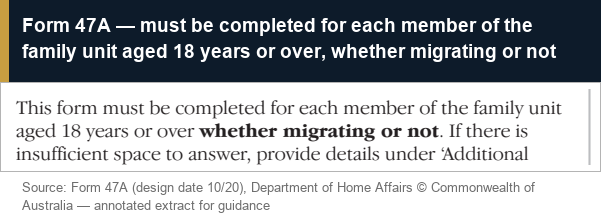
Form 47A must be completed for each member of the family unit aged 18 or over — whether migrating or not. That is the point people trip on. A dependent adult child who is staying behind, a dependent parent who is not coming with you, still needs to be declared. The Department wants a complete picture of your family unit, not only of the people boarding the plane.
Why it matters later: a family member you failed to declare can be treated as an undisclosed member of the family unit, which can complicate a later application to bring them out — and, where the omission looks like concealment, it can raise the false-or-misleading-information concerns that shadow every part of an application.
Common mistakes and their consequences
Leaving out non-migrating dependants. The single most common error. If they are members of your family unit aged 18 or over, they go on the form even if they are not migrating.
Getting dependency wrong. Dependency is a defined test, not a feeling. An adult child is not automatically a dependant; support and circumstances must actually establish it.
Inconsistency with Form 80. Where the Department also asks for a Form 80, the family details there and on Form 47A must match.
Running out of space and leaving it incomplete. Where there is insufficient room, provide the detail in the additional-information section rather than abbreviating.
How Form 47A fits your application
Form 47A supports the main application by completing the family-unit picture. In a partner matter it sits alongside Form 47SP; where an adult dependant is being added to a live application, it works with Form 1436; and if family circumstances change after lodgement, that is a Form 1022. If a lawyer acts for you, your Form 956 keeps the correspondence on their desk, and the charges around adding family members live on the Form 990i fee page.
If you have adult children or dependent relatives and are unsure who must go on Form 47A — especially those not migrating with you — book a $97 10-minute chat with me. Declaring your family unit completely now protects the applications you may want to make for them later.
Frequently asked questions
Who must be included on Form 47A?
Each member of your family unit aged 18 years or over, whether migrating with you or not. That includes dependent adult children and other dependent adult relatives who form part of your family unit.
Do I have to include family members who are not migrating?
Yes. Form 47A must be completed for each member of the family unit aged 18 or over whether migrating or not. Non-migrating dependants still have to be declared.
What does "dependent" mean on Form 47A?
Dependency is defined in the Migration Regulations 1994 (Cth) and turns on actual support and circumstances — being an adult child is not enough by itself. If you are unsure whether someone is dependent, get advice before you decide to leave them off.
Why does it matter to declare a non-migrating family member?
An undisclosed member of the family unit can complicate a later application to bring them to Australia, and an omission that looks like concealment can raise false-or-misleading-information concerns across your whole application.
What if there is not enough space on Form 47A?
Provide the additional detail in the additional-information section of the form rather than shortening or omitting information.
Not sure who belongs on your Form 47A? I act for visa applicants and their families nationwide from eight locations. Book your $97 10-minute chat — or if you are ready to engage, start at myvisa.com.au/work.