Withdrawing a visa application feels like a small administrative act. It is not. It is a legal step with consequences that reach your money, your record, and your ability to apply again — and once done, it cannot be undone. Before you lodge Form 1446, understand exactly what you are giving up.
Considering withdrawal? Book a consultation before lodging Form 1446.
I have advised on this decision many times in more than 27 years. Sometimes withdrawing is the right move. Often it is not. The difference is entirely in the detail.
What Form 1446 is
Form 1446, officially Withdrawal of a visa application (design date 07/17), is the written notice by which you withdraw a visa application.
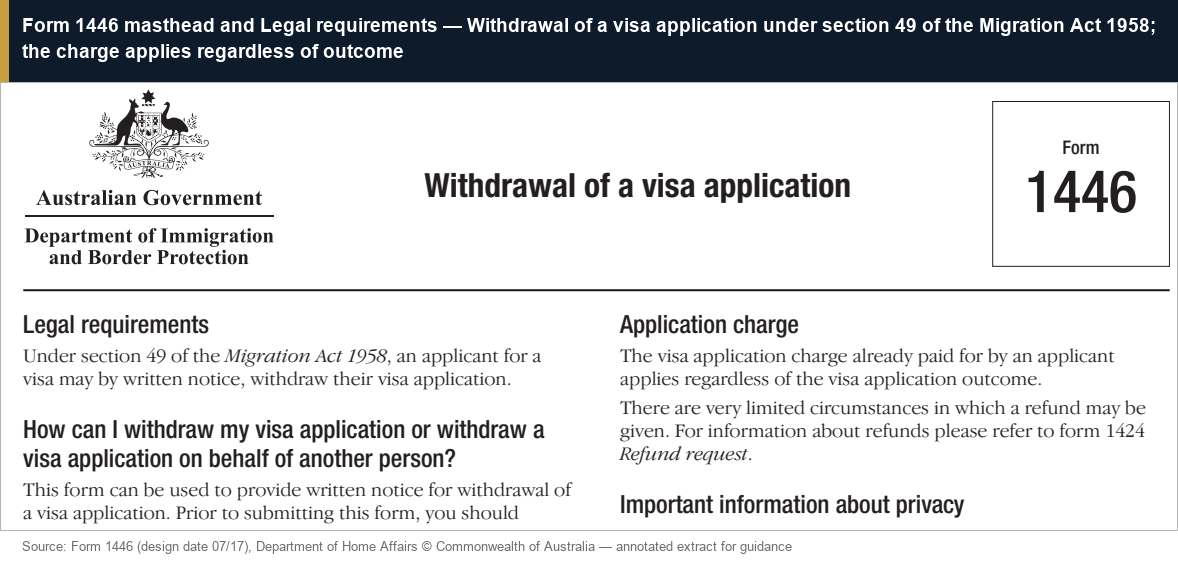
The authority is the Migration Act 1958 (Cth) s 49: an applicant may, by written notice, withdraw their visa application. Form 1446 is that written notice. Download the current form only from the official source: Form 1446 on the Department of Home Affairs website.
The charge is gone
The first hard truth is financial. Your visa application charge applies regardless of the outcome — withdrawing does not get it back. There are only very limited circumstances in which a refund may be given, and those are pursued separately (through Form 1424). Do not withdraw expecting your money to follow you out the door; assume it will not.
One applicant's withdrawal is not everyone's
The second trap catches families. A visa application often includes several people, and withdrawing for one does not withdraw for the rest.
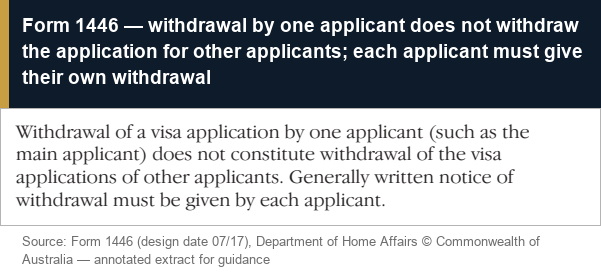
Withdrawal by one applicant — even the main applicant — does not withdraw the application for the others included in it. If the intention is to withdraw the whole application, each applicant's withdrawal must be given. Get this wrong and you may withdraw yourself while leaving dependants in a limbo you did not intend.
The section 48 interaction — the real reason to get advice
This is where withdrawing can help, or hurt, and where I most want you to stop and think.
If you are in Australia and your visa application is refused, the Migration Act 1958 (Cth) s 48 can bar you from making most further onshore applications until you leave. A withdrawal is not a refusal — so in the right circumstances, withdrawing an application before an imminent refusal can preserve options that a refusal would have closed.
But this is fact-specific and easy to get wrong. Withdrawing does not undo a s 48 bar that an earlier refusal already created, and withdrawing the wrong application at the wrong time can leave you worse off, not better. If a refusal is looming and you are onshore, this is precisely the moment to get advice before you touch Form 1446 — not after.
Common mistakes and their consequences
Withdrawing to "start fresh" without checking s 48. If you are onshore, your ability to lodge again may be constrained. Check before you withdraw.
Assuming a refund follows. It generally does not. The charge is spent.
Withdrawing for one and thinking it covers the family. Each applicant must withdraw their own part.
Treating withdrawal as reversible. It is not. Once the notice is given and acted on, the application is gone.
How Form 1446 fits your situation
Form 1446 is the opposite of Form 1436, which adds an applicant to a live application — both are things you do to an application after lodgement, and both reward careful timing. If your circumstances have changed but you do not want to withdraw, a Form 1022 may be the better instrument. For anything to do with the charge or a possible refund, the Form 990i fee page is the place to start.
And if the alternative to withdrawing is a refusal you could instead challenge, remember that a refusal is not the end — it may open a visa appeal. Whether to withdraw or to fight is exactly the kind of decision I am asked to weigh. If a lawyer acts for you, your Form 956 keeps me across the correspondence so the timing is right.
Before you withdraw anything, book a $97 10-minute chat with me. Ten minutes now can be the difference between preserving your options and closing them permanently.
Frequently asked questions
How do I withdraw a visa application in Australia?
By giving written notice under section 49 of the Migration Act 1958 (Cth). Form 1446 is that written notice — complete, sign and lodge it with the Department.
Will I get my visa application charge back if I withdraw?
Generally no. The charge applies regardless of the outcome, and only very limited refund circumstances exist (pursued separately through Form 1424). Assume the charge is not refundable.
If the main applicant withdraws, does that withdraw the whole application?
No. Withdrawal by one applicant does not withdraw the application for the others included in it. Each applicant must give their own withdrawal if the whole application is to be withdrawn.
Does withdrawing a visa application avoid the section 48 bar?
It can, because a withdrawal is not a refusal, and the section 48 bar is triggered by a refusal or cancellation. But it is fact-specific, it will not undo a bar an earlier refusal already created, and getting it wrong can hurt you. Get advice before withdrawing if you are onshore.
Can I reverse a withdrawal?
No. Withdrawal is not reversible. Once the notice is given and acted on, the application is at an end.
Thinking about withdrawing an application? I act for visa applicants nationwide from eight locations, and I weigh withdrawal against every alternative first. Book your $97 10-minute chat — or if you are ready to engage, start at myvisa.com.au/work.