Everyone makes mistakes on immigration paperwork. A misremembered date, a visa refusal you genuinely forgot, an employment period that doesn't match your payslips. What separates a recoverable mistake from a catastrophic one is usually not the error itself — it is what you do once you find it.
Form 1023 is the Department of Home Affairs form for correcting an answer that was wrong when you gave it. Used well, it is the strongest protection available against the most feared provision in the visa system. Used carelessly, it can hand the Department the case against you. I will explain both.
What Form 1023 is
Form 1023, officially titled Notification of incorrect answer(s), discharges a set of statutory duties — and the form's opening text summarises them precisely.
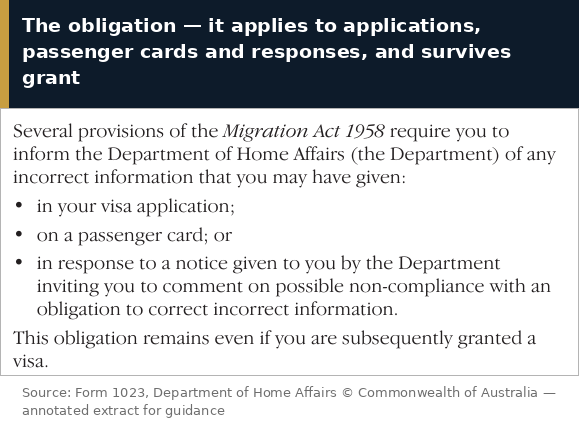
The Migration Act 1958 (Cth) requires you to tell the Department about incorrect information you have given in a visa application, on a passenger card, or in response to a Departmental notice — that is the scheme of ss 101 to 105. Section 101 requires application forms to be completed correctly; s 105 requires you to notify the Department as soon as you become aware an answer was incorrect.
And note the line the form states in terms: the obligation remains even if you are subsequently granted a visa. Unlike the changed-circumstances duty, this one does not switch off at grant.
Download the current form only from the official source: Form 1023 on the Department of Home Affairs website.
Form 1023 versus Form 1022: wrong versus changed
The pairing is simple once stated. Form 1022 is for answers that were true but are no longer current — you moved, you married, you changed passports. Form 1023 is for answers that were never correct — the date you misremembered, the refusal you omitted, the qualification described more generously than the certificate supports.
The distinction has teeth. Lodging a 1022 to quietly "update" an answer that was always wrong does not cure the original incorrectness — the statutory problem, and the cancellation exposure that comes with it, stays exactly where it was.
Why this form matters: PIC 4020 and section 109
Two provisions give Form 1023 its stakes.
Public Interest Criterion 4020 — Migration Regulations 1994 (Cth) sch 4 item 4020 — allows refusal where false or misleading information or bogus documents are given, and a PIC 4020 refusal generally carries a three-year bar on further visas, ten years where identity is in doubt. I have written a full guide to PIC 4020; the short version is that it does not require dishonesty — carelessness can be enough.
Section 109 of the Migration Act 1958 (Cth) permits cancellation of a visa that was granted on incorrect information — which is why the obligation surviving grant matters so much. The form's own warning pages set out the cancellation consequences.
Here is the part that makes Form 1023 worth understanding rather than fearing: a prompt, voluntary, well-framed correction is the best evidence you will ever have that you were not seeking to mislead. A correction lodged before the Department writes to you sits very differently — on refusal, on cancellation, and before the Administrative Review Tribunal if it comes to that — than an admission extracted after a s 107 notice of possible cancellation arrives.
How to complete it
The operative part of the form is disarmingly simple, and its structure is the discipline.
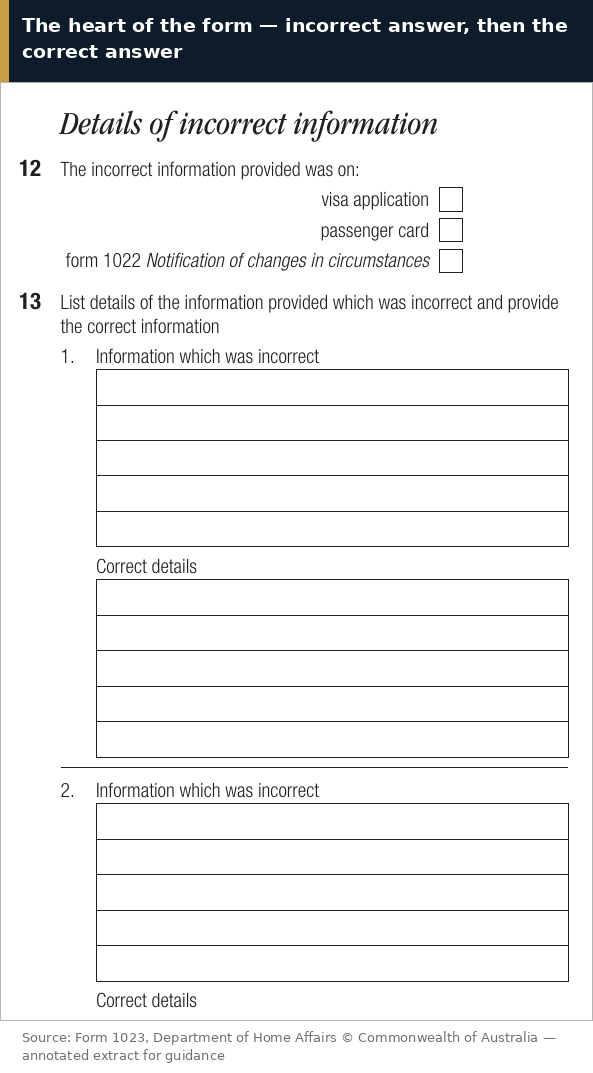
For each item: the incorrect answer exactly as you gave it, where you gave it (which form, which question, which date), and then the correct answer in full. Precision is respect for the process — "Question 23 of Form 80 lodged 14 March 2026 stated employment at X from January 2020; the correct start date is August 2020" leaves nothing to interpretation.
Three rules from more than 27 years of doing these:
Correct everything at once. A Form 1023 that fixes one error while leaving another discoverable is worse than none. Audit the whole application before you lodge the correction.
Explain without excusing. A short, factual account of how the error occurred — a transposed date, reliance on an old CV — belongs with the correction. A defensive essay does not.
Get advice before lodging when the error is serious. If the incorrect answer touches character, identity, relationship claims or previous refusals, the framing of the correction may be the most consequential paragraph in your whole file. This is precisely the situation my $97 10-minute chat exists for — before the form goes in, not after.
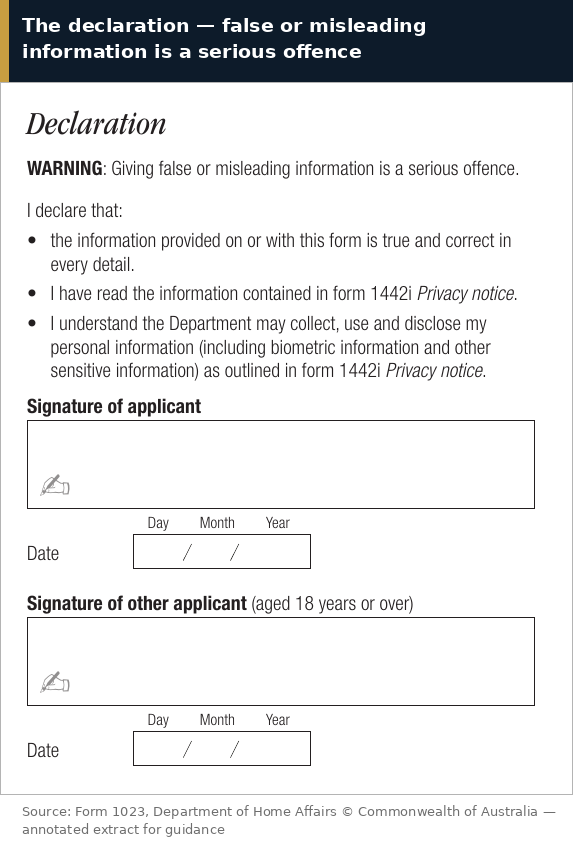
Then the declaration — signed and dated, with the same seriousness the form has warned about throughout.
How to lodge it
Upload the completed form through ImmiAccount against your application, or give it to the office handling your case; if a representative acts under a Form 956, they lodge it and keep the acknowledgement. Keep your copy permanently — every future application, including citizenship, will be assessed against a file that now contains both the error and your correction of it. That is not a weakness. Handled properly, it is a record of candour.
Frequently asked questions
When should I use Form 1023?
As soon as you become aware that an answer you gave the Department — on an application form, a passenger card, or in response to a notice — was incorrect when you gave it. The s 105 duty applies from the moment you know.
What is the difference between Form 1023 and Form 1022?
Form 1023 corrects answers that were wrong when given. Form 1022 reports answers that were true but have changed. Using 1022 for an originally wrong answer does not fix the problem.
Does correcting a mistake with Form 1023 protect me from PIC 4020?
It is not a guarantee, but a prompt voluntary correction is strong evidence against any suggestion you sought to mislead — and it is far better than the Department discovering the error first.
Do I still need to correct an answer after my visa is granted?
Yes. The form states expressly that the obligation remains even if you are subsequently granted a visa, and s 109 cancellation exposure continues for visas granted on incorrect information.
Can Form 1023 be used for someone else's error — like my agent's?
Yes. The answers are yours in law regardless of who typed them, so correct them under your name. How the error arose can be explained in the form.
Should I get legal advice before lodging Form 1023?
For trivial corrections, no. Where the error touches character, identity, relationships or previous refusals — yes, and before lodgement, because the framing cannot be redone.
Related reading: If the error came to light because the Department wrote to you, see my guide on natural justice letters (s 56 & s 57) — how to respond and correct the record properly.
Found an error in something already lodged? The clock on candour runs from now. Book your $97 10-minute chat or engage me at myvisa.com.au/work.