When your visa matter moves from the Department of Home Affairs to the Administrative Review Tribunal, one thing that does not move with it is your representative's authority. The Form 956 that put your lawyer on the record with the Department means nothing to the Tribunal.
Form MR5 is how the ART is told who acts for you — and, just as importantly, where your hearing notices and decision will be sent. In a jurisdiction where deadlines are strict and non-extendable, that second function is not administrative trivia. It is the whole game.
What Form MR5 is
Form MR5, Appointment of Representative, is the Administrative Review Tribunal's form for appointing a representative and/or an authorised recipient in migration and protection reviews. The current version was issued in October 2024, when the ART replaced the Administrative Appeals Tribunal on Monday 14 October 2024 — if the form you are holding says "AAT" on it, it is the superseded version.
You use MR5 when you have already applied for review and want to appoint or change a representative. If you are only now lodging the review application, the application forms — Form M1 for migration decisions and Form R1 for protection decisions — contain their own representative sections, and no separate MR5 is needed at that point.
Download the current form only from the official source: the MR5 form on the ART website.
Who can represent you at the ART
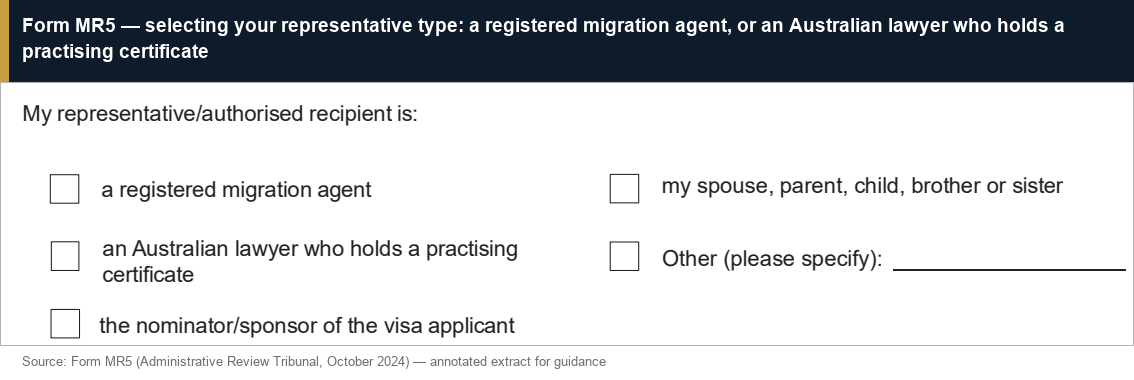
Not everyone can. Providing immigration assistance — using knowledge of migration procedure to prepare or represent you in an ART review — is regulated by the Migration Act 1958 (Cth), and the form reflects it. Your representative can be:
A registered migration agent. Where the form's details refer to a migration agent, their details and signature operate as the notification required by s 312B of the Migration Act 1958 (Cth) that they are providing immigration assistance in the review.
An Australian lawyer who holds a practising certificate. The form asks for the lawyer's Australian Legal Practitioner Number. The form itself draws the distinction that matters here: some registered migration agents are also lawyers, and the form directs you to select the capacity in which the person actually represents you. I appear at the Tribunal as an Australian legal practitioner — that is the box that describes me. The only fee-charging categories the form recognises are the registered migration agent and the Australian lawyer with a practising certificate. Nobody else can lawfully charge you for this work.
Certain unpaid helpers. A close family member — spouse, child, parent, brother or sister — or your sponsor or nominator can assist without being either of the above, but never for a fee.
The authorised recipient: the part that decides where your deadline starts
The MR5 does double duty: the same form nominates your authorised recipient — the person to whom the Tribunal sends all correspondence, including hearing invitations and the decision itself.
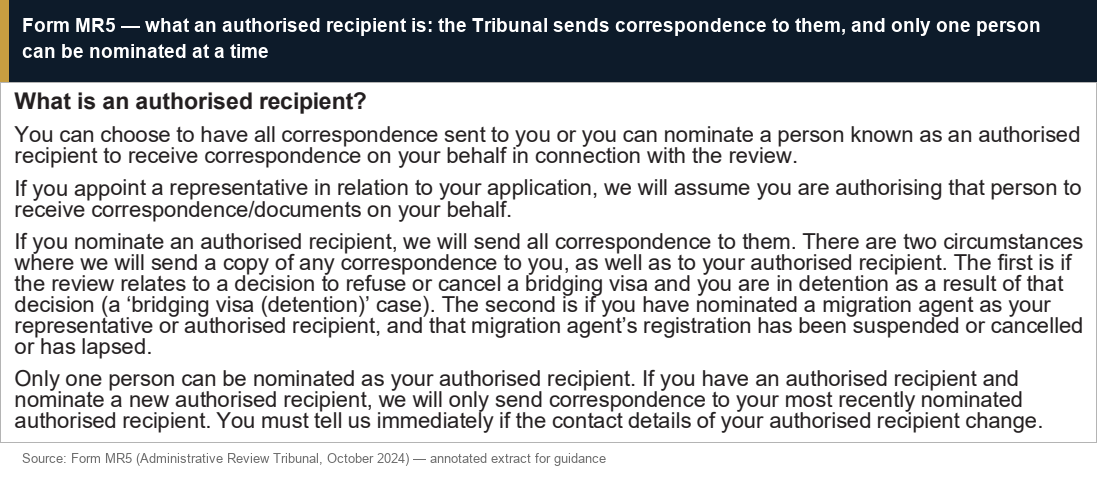
Three rules from the form, each with teeth:
Appointing a representative makes them your authorised recipient by default. The Tribunal assumes the person representing you also receives your documents, unless you say otherwise.
Only one authorised recipient can exist at a time. Nominate a new one and the Tribunal sends correspondence only to the most recent nomination. A stale nomination — the ex-agent, the cousin who helped with the first form — is a live hazard, because documents sent to that person are validly sent to you.
Email consent covers everything. The form lets you agree to all correspondence by email, including hearing notices and the decision notification. In practice this is how it works — which means the email address on this form is the single most consequential data point on it. Check it character by character, and check the junk folder for the life of the review.
Why the fuss? Because ART review periods and hearing-response deadlines run from when the Tribunal gives the document — to your authorised recipient — not from when you personally read it. Missed hearing invitations end reviews; the Tribunal can and does decide cases where the applicant did not appear.
Keeping it current
You must tell the Tribunal immediately, in writing, if you change representatives, cancel a representative's authority, or your representative's details change. The ART has a companion form for changes and cancellations — the MR6 change of contact details form — and until you notify, the Tribunal keeps sending documents to the person on file. If your circumstances change more broadly during the review — address, family composition — the Tribunal expects to be told that too.
When I take over an ART matter from a previous representative, filing a fresh MR5 is the first thing that happens — the same day I am retained — precisely so that nothing further lands in the wrong inbox. If your review is on foot and you are not certain who the Tribunal currently has on file for you, that is worth finding out today, not at hearing time. Book a $97 10-minute chat with me and I will check where your matter stands.
How MR5 fits into the review
The MR5 sits alongside your review application and the Tribunal's fees and deadlines framework — and it is only about the ART. The Department needs its own Form 956; a Federal Circuit Court application needs a notice of acting. Each forum, its own appointment. The full picture of challenging a visa refusal runs across all three.
Frequently asked questions
What is Form MR5 used for?
Appointing a representative and/or an authorised recipient at the Administrative Review Tribunal after a migration or protection review application has been lodged. It tells the Tribunal who acts for you and where to send all correspondence.
Does my Form 956 cover the Tribunal?
No. Form 956 operates with the Department of Home Affairs only. The ART requires its own appointment — the MR5, or the representative section of the review application form.
Who can charge a fee to represent me at the ART?
Only a registered migration agent or an Australian lawyer who holds a practising certificate. Family members, sponsors and nominators can help, but never for payment.
What is an authorised recipient at the ART?
The single person nominated to receive all Tribunal correspondence on your behalf — hearing notices and the decision included. Documents given to your authorised recipient count as given to you, which is what starts your time limits.
How do I change or cancel my ART representative?
Notify the Tribunal immediately in writing — a new MR5 to appoint a replacement, or the MR6 change of contact details form to cancel an authority or update details.
Is the AAT version of the MR5 still valid?
Use the current ART version (October 2024). The Administrative Review Tribunal replaced the AAT on Monday 14 October 2024, and its forms were reissued.
Review on foot and representation unsettled? The Tribunal writes to whoever is on file — make sure that's the right person. Book your $97 10-minute chat or engage me at myvisa.com.au/work.