A Home Affairs refusal is not the end of the road. For most migration decisions there is a right of merits review at the Administrative Review Tribunal — and Form M1 is how you start it. But the door to that review closes fast, and it closes hard. If you have just been refused, the clock is already running.
I appear for clients at the Tribunal, and the pattern I dread is the person who came to me a day too late. Here is what Form M1 is, and what you must do now.
What Form M1 is
Form M1 is the Administrative Review Tribunal's Application for review — migration, for persons not in immigration detention and for organisations.
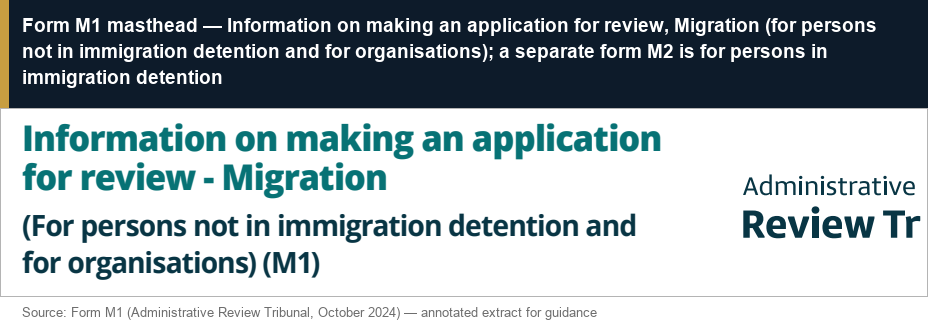
The Administrative Review Tribunal (ART) replaced the former Administrative Appeals Tribunal in October 2024. It reviews migration decisions in its Migration and Refugee jurisdiction — refusals and cancellations that the Migration Act 1958 (Cth) makes reviewable.
If you are in immigration detention, M1 is not your form — the detention variant is Form M2, and detention cases run on much shorter timeframes. Choose the right form for your circumstances from the outset. Access the current forms from the official source: ART immigration and citizenship forms.
The deadline is everything
I cannot say this strongly enough: applications to the ART are subject to strict statutory deadlines that vary by decision type, and the Tribunal generally has no power to extend them for migration decisions. Miss the deadline and your review right is simply gone — no matter how strong your case was.
Your decision letter states the timeframe that applies to you. Read it the day it arrives, and lodge — or get advice — immediately. Do not wait to gather documents; you can do that after lodging. Lodging in time is what preserves the right at all.
Who can represent you — lawyer or agent
The form draws a clear line about who may act for you, and it matters.
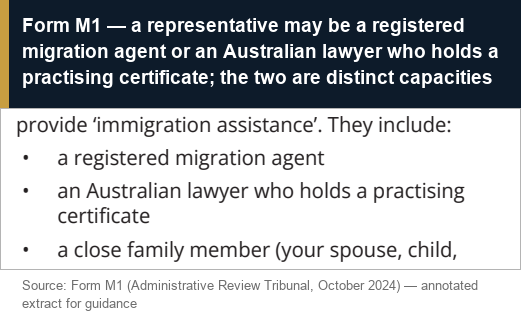
The ART distinguishes a registered migration agent from an Australian lawyer who holds a practising certificate. They are different capacities. I am an Australian legal practitioner — an Australian lawyer who holds a practising certificate — and that is the capacity in which I appear at the Tribunal.
The distinction is not cosmetic. A lawyer brings legal professional privilege and the ability to run the legal arguments a merits review often turns on. When you appoint your representative at the ART, you do it on the Tribunal's own form — Form MR5 — because your Home Affairs Form 956 does not carry across to the Tribunal.
The fee, and help with it
An application fee applies. From 1 July 2026 the migration review fee is $3,727. Two forms of relief exist: the fee may be reduced by 50% on financial-hardship grounds, and where your review succeeds, a partial refund applies. Always confirm the current fee and refund rules on art.gov.au before you rely on them — Tribunal fees are indexed. For the wider fee picture, the Form 990i fee page collects the current figures.
Common mistakes and their consequences
Missing the deadline. The fatal error. It is usually not extendable for migration decisions. Lodge first, perfect later.
Using the wrong form. M1 is for people not in detention; M2 is for people in detention, on tighter timeframes. Match the form to your situation.
Assuming Form 956 covers the Tribunal. It does not. Appoint your representative at the ART with Form MR5.
Doing nothing because the case "feels hopeless". Merits review looks at the decision afresh. Get an honest assessment before you give up a right you cannot get back.
How Form M1 fits your matter
Form M1 begins where a Home Affairs decision ends. It is the migration counterpart to Form R1, which is the ART form for protection (refugee) reviews. Representation at the Tribunal is recorded on Form MR5. And if the Tribunal cannot help — or its decision is itself flawed in law — the next step may be judicial review in the courts, a different and separate pathway I can also advise on. You can read more about how I run visa appeals.
If you have been refused and are not in detention, do not spend your deadline reading — book a $97 10-minute chat with me today. The most valuable thing I can do at the ART stage is make sure your application is lodged in time.
Frequently asked questions
What is Form M1 used for?
Form M1 is the Administrative Review Tribunal's application for review of a migration decision, for people who are not in immigration detention and for organisations. It starts a merits review of a Home Affairs refusal or cancellation.
What is the difference between Form M1 and Form M2?
Form M1 is for applicants who are not in immigration detention (and for organisations). Form M2 is for applicants who are in immigration detention, and detention reviews run on much shorter timeframes.
How long do I have to lodge Form M1?
There are strict statutory deadlines that vary by the type of decision, and for migration decisions the Tribunal generally cannot extend them. Your decision letter states your timeframe — read it and act immediately.
How much does an ART migration review cost?
From 1 July 2026 the migration review application fee is $3,727. It may be reduced by 50% on financial-hardship grounds, and a partial refund applies if your review succeeds. Confirm the current figure on art.gov.au.
Can my Form 956 lawyer represent me at the ART?
Your Home Affairs Form 956 does not carry across to the Tribunal. Representation at the ART is appointed on the Tribunal's own form, Form MR5. A lawyer acts as an Australian lawyer who holds a practising certificate, distinct from a registered migration agent.
Just been refused and not in detention? I appear for applicants at the ART nationwide from eight locations, as an Australian lawyer who holds a practising certificate. Book your $97 10-minute chat — or if you are ready to engage, start at myvisa.com.au/work.