Most people applying for citizenship use the general eligibility form. Form 1290 is for everyone else — the "other situations" the standard pathway does not cover. If a case officer or a guide has pointed you to 1290, it is usually because your route to citizenship is a special one, and special routes reward getting the detail exactly right.
Here is what Form 1290 is, and how to know whether it is your form.
What Form 1290 is
Form 1290, officially Application for Australian citizenship — Other situations (design date 06/26), is the conferral application for people whose eligibility does not fall under the ordinary general-eligibility pathway.
It is grounded in the Australian Citizenship Act 2007 (Cth), which provides for citizenship by conferral across several distinct eligibility categories beyond the standard one. Form 1290 is the form that gathers the right information for those categories. Download the current form only from the official source: Form 1290 on the Department of Home Affairs website.
Is this your form? Check the situations
The form sets out plainly who should use it.
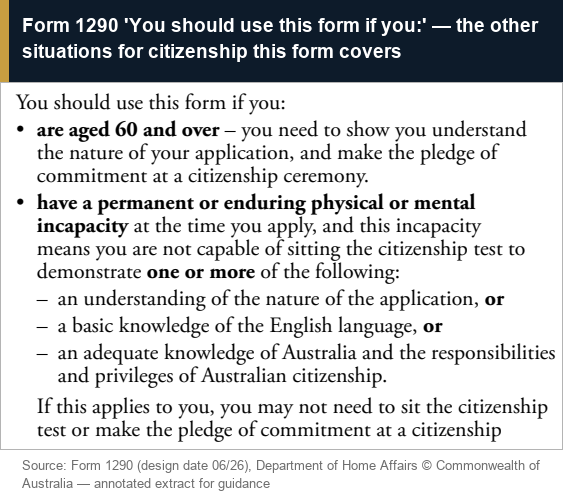
The "other situations" include categories such as a person born to a former Australian citizen, a person who is stateless, a person applying under the special provisions for age or incapacity, and other routes that sit outside general eligibility. If your situation is the ordinary one — a permanent resident who has met the residence requirement — your form is the general-eligibility Form 1300t, not this one. Using the wrong form is a common and costly delay, so confirm your category before you start.
Identity and integrity still apply
Whatever your special situation, the identity and integrity rules are the same as for any citizenship application. Your identity must be established, and false or misleading information can lead to refusal, prosecution and — if fraud emerges after a grant — the loss of citizenship. Where you are applying online in certain citizenship pathways, identity is verified using Form 1195, the Identity declaration; the consistency discipline that governs Form 80 governs here too.
Common mistakes and their consequences
Using 1290 when 1300t is correct (or vice versa). The single most common error. General eligibility uses 1300t; the special categories use 1290. Confirm your category first.
Getting the eligibility category wrong within 1290. The "other situations" are distinct legal routes with distinct requirements. Identify yours precisely.
Under-documenting a special claim. Special-category eligibility usually turns on specific evidence — birth records, a parent's citizenship, statelessness. Assemble it before lodging.
Overlooking children. Children under 16 are generally included on a responsible parent's application rather than applying separately; a 16 or 17 year old has their own path. Check who lodges what.
How Form 1290 fits your citizenship
Form 1290 is one of the citizenship family. General-eligibility conferral is Form 1300t; citizenship by descent is Form 118; proof of an existing citizenship is Form 119; and identity in online descent and evidence applications is Form 1195. If a lawyer acts for you, your Form 956 keeps the correspondence on their desk, and the citizenship fees sit alongside the visa charges collected on the Form 990i fee page.
If you have been directed to Form 1290, or you are not sure which citizenship form is yours, book a $97 10-minute chat with me. Naming your eligibility category correctly at the start saves months later.
Frequently asked questions
What is Form 1290 used for?
Form 1290 is the application for Australian citizenship by conferral for "other situations" — the special eligibility categories under the Australian Citizenship Act 2007 (Cth) that fall outside standard general eligibility.
What is the difference between Form 1290 and Form 1300t?
Form 1300t is for standard general eligibility — typically a permanent resident who has met the residence requirement. Form 1290 is for the other, special situations. Using the wrong one causes delay.
Who counts as an "other situation" for Form 1290?
Categories such as a person born to a former Australian citizen, a stateless person, and applicants under the special age or incapacity provisions, among others set out on the form. Identify your specific category before applying.
Do children use Form 1290?
Children under 16 are generally included on a responsible parent's application rather than lodging their own, while a 16 or 17 year old has their own pathway. Check who should lodge before completing anything.
Does identity verification apply to Form 1290?
Yes. Identity must be established for any citizenship application, and false or misleading information can lead to refusal, prosecution and loss of citizenship. In certain online pathways, identity is verified using Form 1195.
Not sure which citizenship form is yours? I act for citizenship applicants nationwide from eight locations. Book your $97 10-minute chat — or if you are ready to engage, start at myvisa.com.au/work.